

.png?width=1300&name=AI_V3%20(1).png)
12.1.2026
Sandy Bekheet
 Share this
Introduction
Everywhere you look, there’s a new promise about agentic analytics: BI tools that don’t just show data but think, suggest, and even act on your behalf. It sounds great, and maybe it is.
This isn’t another explainer about what agentic analytics is. You’ve probably seen enough of those.
Instead, we’ll look at what really matters: when these tools make sense, what you need in place to get value from them, and how to tell if your company is ready to make the move or better off waiting a little longer.
The shift toward AI-augmented analytics is already happening. The Gartner Magic Quadrant for Analytics and BI 2025 report shows that companies are increasingly moving AI-driven capabilities from pilots into everyday use (find out more in our Databricks AI Summit summary).
According to Gartner, tools like ThoughtSpot and Tellius stand out in this landscape because they were built as AI-first, search- and conversation-driven analytics platforms, while mainstream platforms such as Power BI and Tableau are adding agentic features through Copilot and Tableau Pulse.
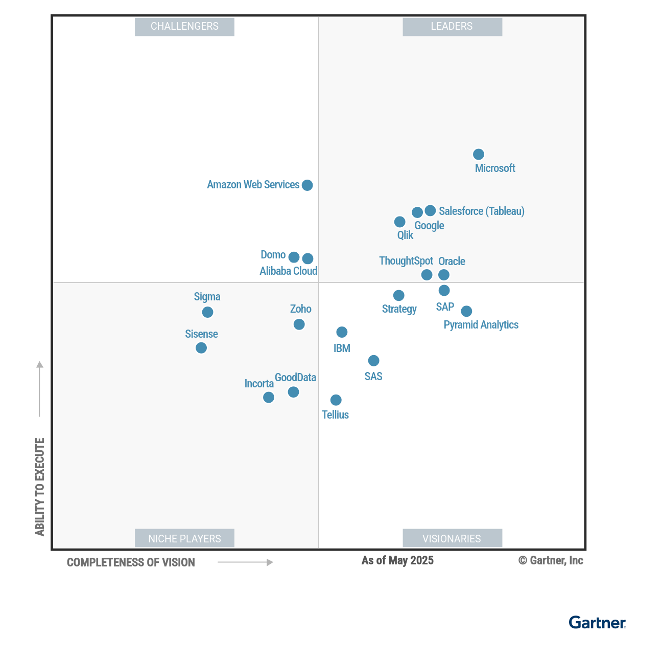
Source: Magic Quadrant for Analytics and Business Intelligence Platforms report, June 2025
By asking yourself a few key questions, you can get a clearer sense of whether an AI-driven BI tool is the right fit for your organization today or what steps you might need to take to prepare for a successful move in the future. Below are the questions we’re asked most often in conversations with our clients:
Q1: Would my current BI setup need refactoring before an agentic analytics tool could actually add value?
Most likely yes, as agentic analytics tools rely heavily on clean, consistent, and well-structured data to generate accurate insights. That means having your data warehouse with all relevant sources connected and your data cleaned up (e.g., consistent naming, no missing data) and modelled (e.g., facts and dimensions tables, same level of aggregation). The structure should be clear and consistent, so that AI knows where to find things and how they relate to one another.
Once that foundation is in place, the next step is modeling. For agentic analytics tools, this often means using dimensional modelling – modelling built around fact and dimension tables that make business relationships easy to interpret.
Before setting it up, it’s worth validating that the tools you’re evaluating are designed to work well with this structure by reviewing their documentation or discussing recommended data models directly with the vendors.
It’s important to note that agentic analytics still depends on structured data and clear business logic; it doesn’t replace data modeling.
Q2: Do I need a semantic layer?
A semantic layer acts as a translator between your technical data structures and the business language your team actually uses. It defines what metrics like “revenue,” “customer,” or “active user” mean, and ensures that everyone (including AI) interprets them the same way.
Simplified diagram of a semantic layer positioning within a data stack

If you have basic data governance and a data catalog in place, it becomes much easier to build a semantic model.
If not, workshops or short review cycles between departments’ analysts and business users help align dimensions, measures, and KPI definitions so that all teams share the same understanding. This shared understanding is what allows a semantic layer to work effectively, turning agreed-upon business logic into reusable, consistent metrics. Put simply: semantic models fail when built in silos.
Q3: Does the number of data sources matter?
Yes, but not simply because of the number of sources. What matters more is the schema and semantic complexity they introduce. Each additional source adds tables, columns, and metric definitions that AI must reason over, increasing the likelihood of overlaps or inconsistencies.
For example, different sources may have slightly different versions of “revenue” or use the same column name with different meanings, leading to incorrect interpretations. Starting small helps your teams build trust in the results and spot integration issues before scaling up.
Most companies see the best results when they start with three to five well-structured, high-value sources (e.g., CRM, e-commerce, marketing, or finance) before expanding further.
This range is enough to give the AI context across different parts of the business, while keeping complexity under control to allow it to answer cross-functional questions like how marketing spend influences sales, which campaigns drive the highest-value customers, etc.
Q4: Do I need to do any training? What if our users are not tech-savvy?
Yes, you will need some training, but it doesn’t have to be technical unless you’re involved in setting up the tool.
It's more about getting familiar with the interface, learning how to ask clear business questions, and developing the habit of critically reflecting on the answers. It also helps users gain a basic understanding of what the AI does in the background and how to integrate it into their everyday workflow.
If your departments aren’t tech-savvy, that’s actually where agentic BI tools shine, because they’re designed to work in plain language.
You can help teams ask the right questions by giving them clarity, structure, and confidence through workshops, short examples, and shared “good questions” templates. In practice, this works best when questions are tied to existing business processes and reinforced through shared dashboards, such as monthly targets, campaign performance, customer behavior, or product trends.
Q5: Is real-time data possible?
Before answering that question, we’d like to counter with: would real-time data actually change the decisions your teams make?
Agentic analytics itself doesn’t determine whether your data is real-time; it simply sits on top of whatever refresh schedule your existing data warehouse or pipelines provide.
Real-time setups are possible, but they come with higher infrastructure costs, more complex pipelines, and stricter data quality requirements. In some cases, having live visibility prevents issues, enables faster reactions, and supports time-critical operations like monitoring, customer service, or rapid campaign adjustments. But if the business doesn’t truly need it, that investment rarely pays off.
Q6: What about advanced and predictive analytics?
Agentic analytics enhances advanced and predictive analytics because it can surface trends, risks, or opportunities automatically, in plain language, and serve that information directly to business users. Instead of waiting for someone to ask the right question or build a custom model, the system proactively highlights what’s changing and what might happen next, provided that your data is clean and well modeled.
Traditional BI can absolutely support predictive analytics too, but it usually requires separate data science workflows, custom pipelines, and analysts who translate the results into dashboards. It works, but it requires additional investment and data science expertise. The advantage of agentic analytics is that it lowers the barrier to creating these insights, making them easier to access and act upon across the organization.
Q7: How much would it cost beyond licensing to make the shift? Should we wait or go for it now?
That depends. Beyond licensing, you’ll likely need to invest in cleaning and organizing your data, setting up or improving your data warehouse, building a semantic layer, and giving teams some basic training so they can use the tool effectively.
Plus, data engineers or analysts usually need to provide some level of support at the start. Keep in mind, also, that the tools are evolving quickly; early adoption means staying flexible for changes in licensing, features, and integration.
For query-cost, it doesn’t necessarily increase linearly with each user question. When caching, semantic layers, and hybrid query architectures are used, and many questions are answered from cached or pre-computed results. The exact costs of course depend on the tool.
It also doesn’t have to be a black-and-white shift from 100% standard BI tools to 100% agentic analytics. Many companies already use BI tools that include built-in AI assistants or agents, such as Power BI Copilot, Tableau Pulse, Qlik AutoML, Looker’s NLQ features, and even Sigma’s AI summaries. If you’re already working in one of these ecosystems, enhancing your existing setup might be enough before considering a new tool.
The question of whether you should move now or wait ultimately depends on your data readiness and team capabilities. If your data foundation is solid and your teams already work with data to make informed decisions, adopting an agentic tool can create value quickly. If your data is messy or your BI setup still needs work, it’s better to fix those basics first.
How we can support you
If you’re exploring agentic analytics or considering a transition towards it, FELD M can support you at every stage of the journey, from selecting the tool that fits your needs to ensuring it can reliably answer your business questions and help your organization move forward. We’d be happy to support you.