Client

Branche
Retail & hospitality
Tools we used


Main objectives:
Step one: Getting three systems to agree on what an order is
Before we touched anything conversational, we had to deal with the part that actually decides whether everything downstream works: point of sale, GA4 and Eventbrite each had their own idea of what a "product" was, and none of them talked to each other.
So we started in BigQuery, and used dbt to build the logic that makes them the same thing: one product, one order, one shared time grain. On top of that, we defined the actual metrics and business terms in Veezoo's semantic layer (knowledge graph) – things like margin, reorder point, what counts as an order, which date fields to refer to. Veezoo inherits the dbt logic and the knowledge graph carries the definitions, so a metric means the same thing whether it comes from a chat or a dashboard (known as canvases in Veezoo).
Step two: Exploring first, then deciding what's worth reporting on
With the model in place, we explored the data conversationally rather than specifying reports up front. Reviewing the questions in Veezoo showed which aspects of the data the team kept returning to, and those became canvases.
Exploration also surfaced things the reporting had not covered before. Corkage, the charge for drinking a purchased bottle on site, is a line item in the point-of-sale data. Joining it back to the other products in the same order showed which bottles guests open in the space rather than take home, which the source system does not report at all.
The outcome: Self-service analytics that actually holds up
With the groundwork done, Forever Thirsty is now able to chat right away with the data, build visualizations, and dig as deep as they want.
The team gets answers without writing SQL: bar versus shop on margin, reorder decisions by comparing volume against margin, corkage showing which bottles are opened on the spot rather than taken home.
For recurring questions, we put agents on the same semantic layer:
-
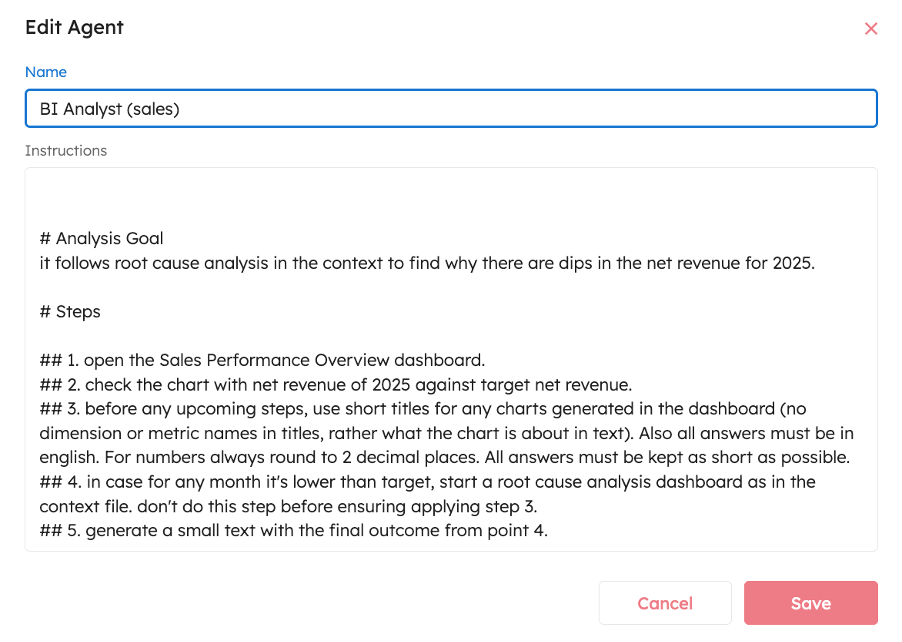
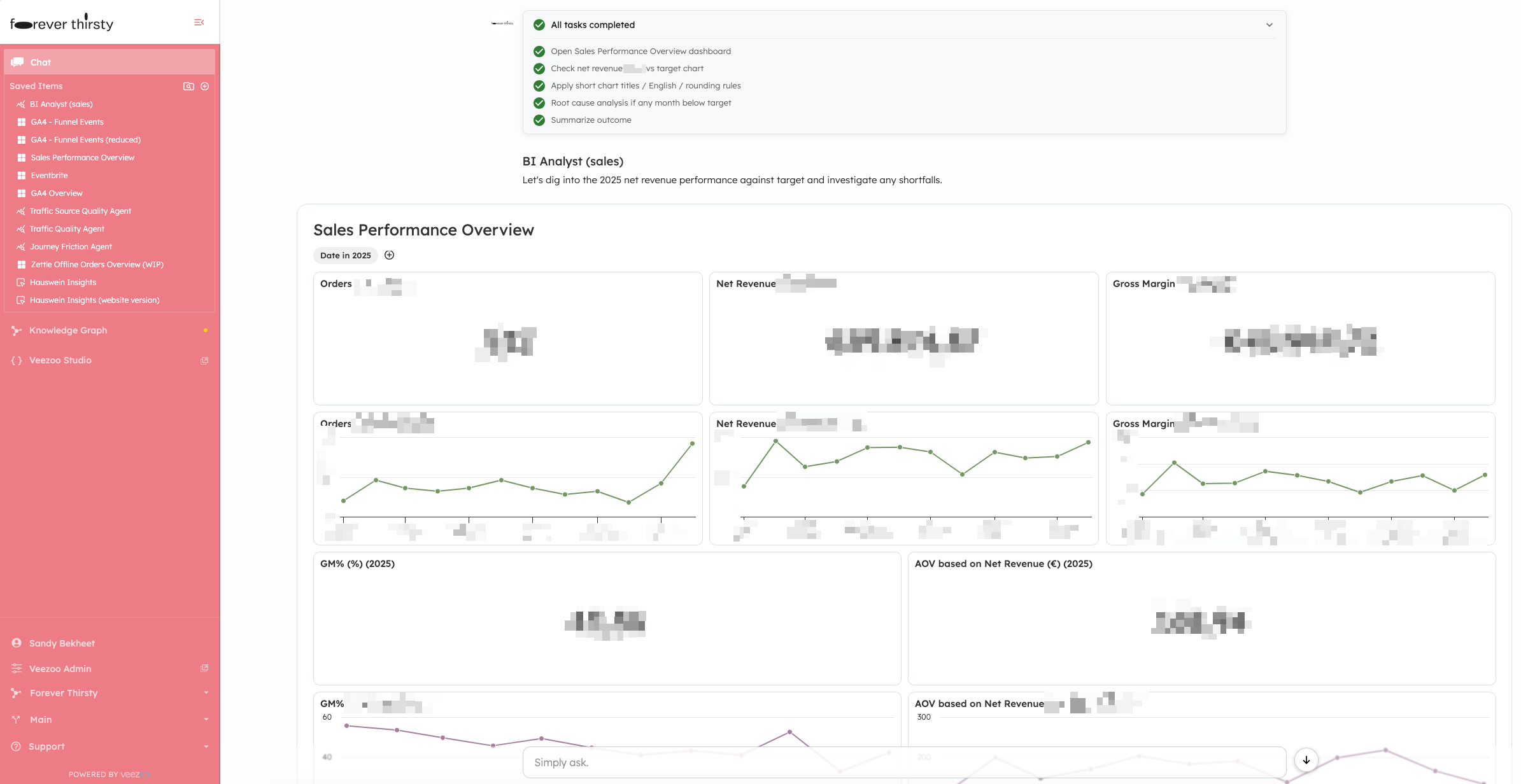
One agent checks net revenue against target monthly, and if a month falls short, it opens a root cause dashboard on its own and summarizes what it found.
-
Another, a Journey Friction agent, flags where GA4 sessions lose momentum after landing and returns a short diagnosis: pattern, likely cause, next step, labeled by confidence.
Both run on schedule and land in the team's email or Slack.
One of the things we added to enhance the results was context files. They include information like: what Forever Thirsty is, the history of the company, and information about the company’s vision and goals. In addition, in the agent instruction, we included fixed instructions for the formatting, answer length, decimal places and number of charts generated, etc.
Especially for the multi-step root-cause analysis, we found that the agent could easily lose its way and generate a lot of charts during the reasoning steps. After some trials and fine-tuning, we got the expected results.
Example of how the agent is defined:
Example of the results in the Veezoo user interface:
Futureproofed: From self-service answers to proactive analysis
The result is more than a collection of dashboards. Now analyses can use the same definitions and business context with chats.
Forever Thirsty already uses scheduled agents to monitor performance and investigate recurring questions. These agents can carry the context of a useful analysis into a repeatable workflow, moving the team from checking reports manually to receiving relevant findings when action is needed.
The same foundation also leaves room for more advanced use cases as the business grows, such as threshold- or anomaly-based monitoring, and forecast-aware or what-if analysis. These can be added without rebuilding the business logic in a separate report each time.
This turns analytics from an external service into a capability the team owns: new questions can be explored conversationally, recurring checks can run proactively, and more sophisticated analyses can be introduced on top of the governed model.
Have a similar project?
Let's find out together how we can help!
-
Data engineering & architecture

A uniform platform for all social media dashboards
Tools we usedRead now
-
Data strategy

Accessible and actionable marketing data
-
Analytics & BI
Startup
From local startup to global expansion
Tools we usedRead now
-
Analytics & BI
Asset management
How to create a customized dashboard for visualizing marketing campaign performance
Tools we usedRead now