


1.12.2025
João Santos
 Share this
Introduction
Our team recently attended this year’s Databricks Data + AI Summit, where industry experts and data practitioners gather annually to explore how data platforms are evolving to support real-world AI applications. I'm Joāo Santos, a Data Architect at FELD M, and I've put together my key takeaways from the event for you.
First off, the central theme was clear: the summit centred around how organizations can move from data management to AI deployment at scale.
Key points
Agent Bricks simplifies the process of building and testing AI agents.
AI/BI Genie helps non-technical users explore and explain data in natural language.
Lakebase introduces a serverless, open-source database built for AI-driven workloads.
Unity Catalog remains the foundation for secure and governed data access.
Companies like BASF and Boehringer Ingelheim are already building practical GenAI applications.
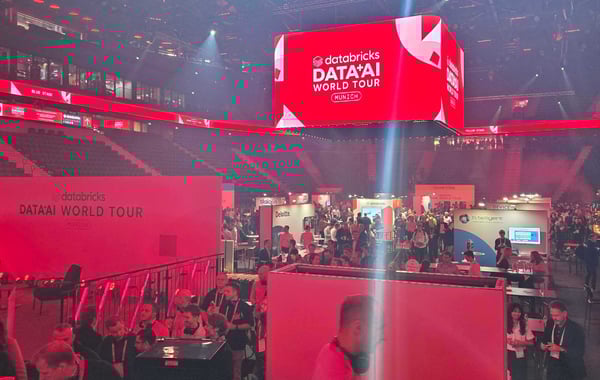
An overview of Databricks’ expanding AI ecosystem: From agents to data infrastructure
Agent Bricks – Simplifying AI agent development
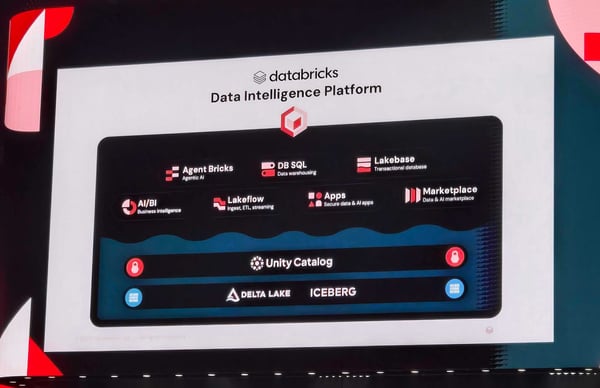 Introducing: Agent Bricks, a new framework designed to make it easier to build and evaluate Retrieval-Augmented Generation (RAG) agents. Since we've been writing and learning a lot about RAG systems this year, this really caught our attention. Here's the elevator pitch:
-
It's a one-stop environment for creating AI products without deep MLOps expertise.
-
It includes automated feedback loops and a no-code evaluation system for faster iteration.
-
It's best suited for simple to mid-level use cases, as production deployments are still in the process of maturing.
Though this is a great option for simpler use cases, Databricks noted that more advanced users continue to rely on the Mosaic AI Platform, which provides the flexibility to fine-tune each component in the AI development process.
AI/BI Genie – data exploration for everyone
The new AI/BI Genie stood out for its potential to transform how non-technical users interact with and analyze data.
Instead of submitting yet another dashboard request, users can now ask questions in plain language and explore data directly. Genie promises to not only visualize trends, but even to explain anomalies and spikes by identifying related data points across sources.
This evolution moves organizations closer to true self-service analytics, helping teams make decisions based on real insight rather than static reports. We're curious to see how this develops over time.
Lakebase and Unity Catalog: the core of AI readiness
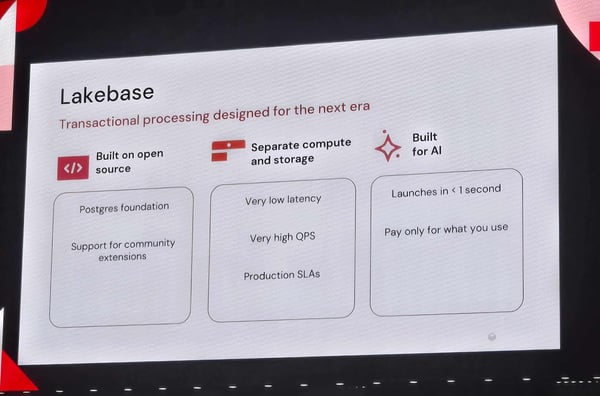
Databricks also introduced Lakebase, a new OLTP database architecture built on open-source Postgres technology and tightly integrated with the lakehouse. Here are the key features:
-
Adherence to open standards: Lakebase extends Postgres with Databricks’ unified approach to storage and compute, ensuring ongoing compatibility with open-source tools.
-
Separation of storage and compute: Data is stored in open formats while compute resources can be scaled independently, improving flexibility and cost efficiency.
-
Serverless by design: Lakebase automatically scales up or down according to workload demand and can pause when idle, ensuring you only pay for what you use.
-
High concurrency for AI workloads: Lakebase supports simultaneous access for multiple users or agents, making it well-suited for AI-driven and operational applications.
-
Preserves OLTP performance: It combines transactional speed with the scalability and openness of the lakehouse model.
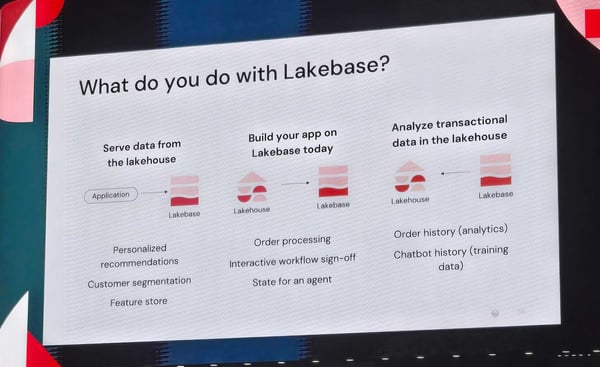
Together with Lakebase, the Unity Catalog continues to serve as the governance backbone of the Databricks ecosystem. It manages access, data lineage, and security across all assets—an essential layer when teams and AI agents share the same platform.
Customer highlights: Real-world AI in action
Two case studies showed how organizations are already applying Databricks solutions in real-world AI solutions.
BASF: Building a multifunctional AI assistant
BASF, the German multinational chemical company, developed a multi-agent system accessible via MS Teams and internal web apps. It uses computer vision to process visual data such as charts and reports.
It's a great example of how large organizations can integrate AI across multiple workflows.
Boehringer Ingelheim: Automating compliance with RAG
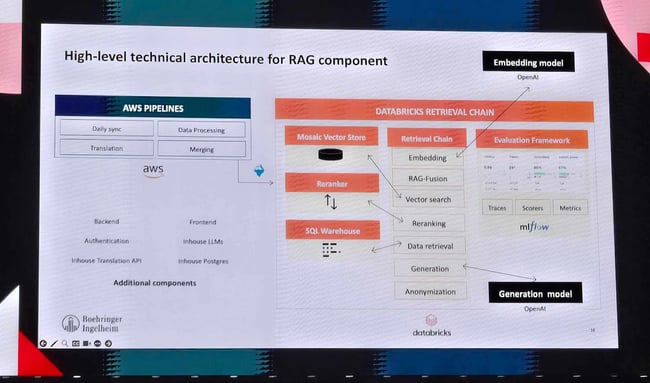
The German pharma company uses Databricks’ Retrieval Chain to streamline its compliance document management. It automates document search and generation, reducing manual effort and improving efficiency and accuracy in this highly regulated environment.
What we learned from the Summit
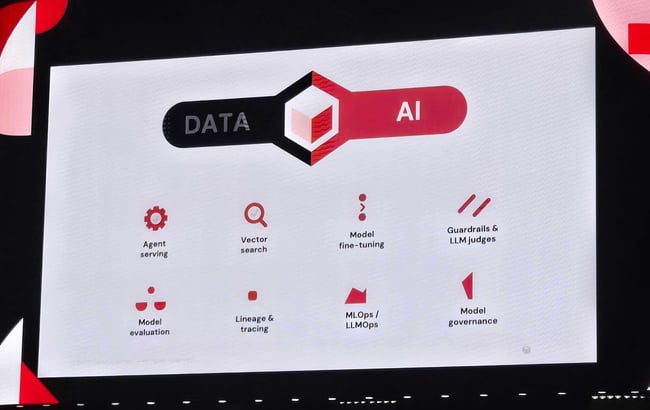
The 2025 Databricks Summit confirmed that data and AI are now fundamentally linked.
-
AI is driving internal optimization, and these advances are laying the groundwork for external, client-facing solutions.
-
With tools like Unity Catalog, Lakebase, and Agent Bricks, Databricks is helping teams move from experimentation to production with fewer technical barriers.
-
The overall trend: AI adoption is rapidly moving into everyday business practice.
What does your AI journey look like so far?
We hope this summary supports your next steps toward operationalizing AI. At FELD M, we specialize in connecting data strategy with real-world AI delivery, from modernizing data architecture to deploying AI assistants for measurable impact.
If you want to explore how to bring AI agents into production using your current data infrastructure, we’d be happy to discuss how we can help.
👉 Get in touch with us to learn more about how we can help you turn data into intelligent action.